How Dementia & Alzheimers Can Negatively Affect Dental Health
When Someone You Love Stops Letting Anyone Treat Their Teeth
Caregivers often describe a familiar scene: approaching with a toothbrush, only to have their loved one clamp their mouth shut. They try again, gently, and the person turns their head away or grabs their wrist. Maybe they've started spitting, crying, or just going completely rigid the moment they sense what's coming.
For caregivers of someone with dementia, Alzheimer's, or significant cognitive decline, this scene often feels painfully familiar, and it usually leaves families wondering whether their loved one's teeth are okay, whether they're doing something wrong, and whether anyone can actually help.
What caregivers are experiencing isn't unusual, and they're not failing. Resistance to oral care isn't stubbornness, and it isn't a personal rejection. It's a documented symptom of cognitive decline, rooted in how the brain processes unfamiliar sensations, perceived threats, and loss of control.
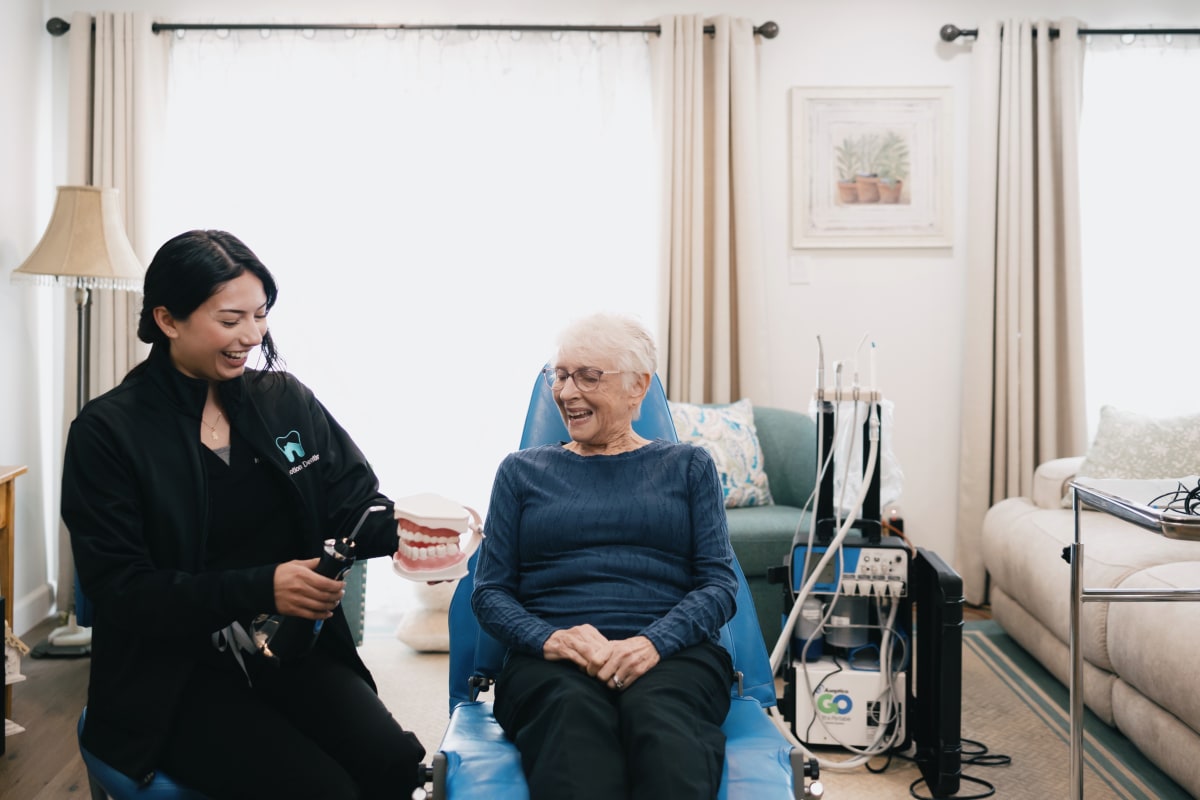
Many families throughout Los Angeles County, Orange County, and San Diego County tell us they've been turned away from traditional dental offices or told "there's nothing we can do here" when their loved one couldn't cooperate with standard procedures. Dr. Banner and his team have spent over 10 years providing house call dental services specifically for patients who can't access traditional care.
We work with patients who have dementia, Alzheimer's, special needs, and complex medical conditions who need a completely different approach. The path forward doesn't require getting a loved one into a car, through a waiting room, or into a dental chair they'll fight every step of the way. It starts with a phone call to (626) 594-0374.
What Dementia and Alzheimer's Can Do to the Mouth
Most people understand that dementia and Alzheimer's affect memory, behavior, and daily functioning. What gets far less attention is what these conditions do to the mouth, and the consequences are serious enough that families and caregivers really need to understand them before problems become advanced.
When we arrive at a patient's home for the first time, one of the most common things we see is not just one dental problem, but years of gradual decline that went unnoticed. It usually starts with medication.
How Medications Create a Perfect Storm
People living with dementia or Alzheimer's are commonly prescribed antidepressants, antipsychotics, and antihistamines, and nearly all of these reduce saliva production as a side effect. Saliva isn't just comfort fluid. It actively protects teeth by neutralizing acid, washing away food particles, and slowing bacterial growth. When the mouth stays dry, decay accelerates in ways that can genuinely shock families who assumed their loved one's teeth were holding up.
At the same time, the daily brushing routine quietly disappears. Not because the person is being difficult, but because the cognitive steps required to pick up a toothbrush, apply toothpaste, and follow through with the motion are exactly the kind of sequenced tasks that dementia and Alzheimer's dismantle early. Plaque builds up fast when brushing becomes inconsistent, and in a dry mouth environment, that buildup leads to cavities and gum disease at a pace most people don't expect.
The Physical Changes That Accelerate Breakdown
Dementia and Alzheimer's also affect motor control and coordination. Jaw muscles weaken, swallowing becomes less efficient, and the ability to clear food from the mouth diminishes. These physical changes mean food stays in contact with teeth longer, creating more opportunities for bacterial growth.
Chewing becomes harder as sore teeth, poorly fitting dentures, and weakened jaw control push people toward softer foods. Soft foods tend to be starchy or sweet, and that dietary shift feeds the very bacteria causing the decay. It becomes a cycle that compounds on itself.
Then dental visits stop entirely. Transportation becomes too difficult, the appointment environment becomes overwhelming, and care gets quietly deprioritized. By the time families reach out to us, they're often describing heavy plaque and tartar buildup, untreated cavities, broken or worn teeth, loose teeth, poorly fitting dentures, root decay, and food packing around teeth or restorations. A mouth that has been deteriorating for years without anyone fully realizing it.
The mouth breaks down faster in this population, and the window for simpler treatment closes sooner than it should. Understanding why that happens is the first step toward doing something about it before the situation becomes urgent.
Why Resistance to Dental Care Is a Symptom, Not a Choice
When a person with dementia or Alzheimer's pulls away from a toothbrush, clamps their mouth shut, or becomes visibly distressed the moment someone approaches with dental instruments, it may appear to be stubbornness or a behavior problem. It isn't. What's actually happening is neurological, and understanding that distinction changes everything about how care should be approached.
Dementia and Alzheimer's progressively damage the parts of the brain responsible for sequencing, communication, and sensory processing. That means something as routine as "open your mouth and hold still" requires a chain of cognitive steps that may simply no longer be intact. A person who cannot follow multi-step instructions isn't being uncooperative. They genuinely cannot process the request the way they once could.
When the Brain's Threat Response Takes Over
Sensory hypersensitivity adds another layer. Many people living with Alzheimer's or other forms of dementia experience sounds, lights, touch, and unfamiliar smells far more intensely than they used to. A dental office, with its overhead lighting, instrument sounds, and clinical smells, can be genuinely overwhelming. Add in the disorientation of being moved to an unfamiliar environment, and the brain's threat response kicks in.
There's also the pain communication problem that families often don't recognize. A person who can no longer reliably express discomfort verbally may have a cracked tooth, an infected area, or sore gum tissue that no one knows about. We regularly see patients who seem more agitated, avoid dentures, resist brushing, or show behavior changes that are actually tied to pain or infection.
This is why so many standard dental offices struggle with these patients. It isn't always a lack of compassion but rather a lack of the right environment, the right pace, and the right understanding of what's actually driving the resistance.
The Behavioral Approaches That Actually Work
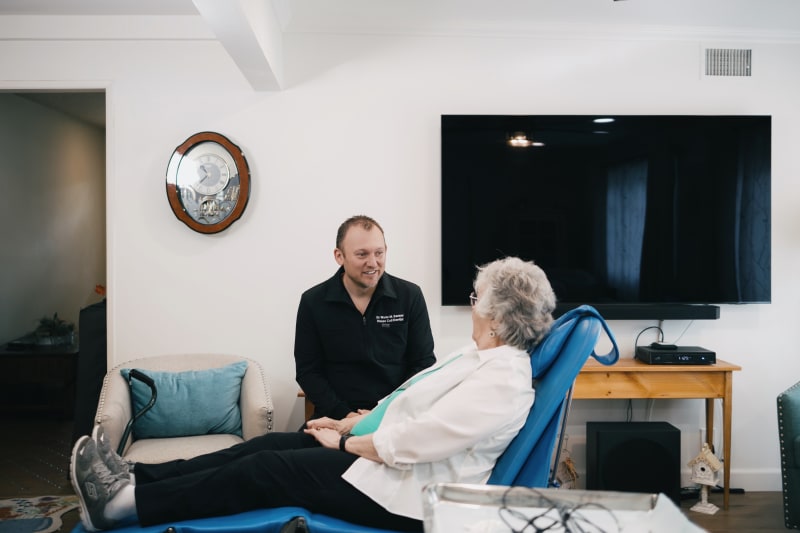
Families who have been turned away or told "there's nothing we can do here" find a different experience with In Motion Dentists. The difference isn't just that we come to the patient. It's how we actually behave in the room with someone whose world can feel very confusing, very fast.
Meeting Patients Where They Are
Consider a patient with moderate dementia or Alzheimer's who doesn't fully understand what's happening when a stranger leans over them with unfamiliar tools. A traditional dental environment (the bright overhead light, the sounds, the chair that reclines without warning) can trigger real distress in patients who are cognitively impaired. So we don't start there. We start by meeting them where they are, literally and emotionally.
When someone with dementia stays in their familiar bedroom or their usual chair at the memory care facility, they're already starting from a calmer baseline. There's no disorienting car ride, no unfamiliar waiting room, no transfer to a surface that feels unstable. That familiarity isn't just a comfort perk. It's a clinical advantage, because a calmer patient is a safer patient.
Timing and Communication Techniques
Many patients with dementia and Alzheimer's have a cognitive window where they're most alert, cooperative, and able to tolerate interaction. For a lot of people, that window is mid-morning, after the morning routine has settled but before fatigue sets in. Scheduling around that window isn't always possible, but when it is, it changes everything about how the visit goes.
During the appointment itself, we use a version of tell-show-do that's adapted for patients with limited comprehension. We don't explain procedures in clinical terms. We use simple, familiar language, repeated calmly and consistently. "I'm going to look at your teeth now. Just like this. Good." We say it the same way, in the same tone, more than once. Repetition isn't condescending in this context. It's grounding.
We work in short intervals with planned breaks built in, not just when a patient shows distress, but proactively. A patient who feels like they can stop doesn't need to stop as often. When someone needs physical guidance, we use hand-over-hand support gently, so they understand what's happening through touch before anything else occurs. It's a way of communicating that doesn't rely on language at all.
What families often tell us is that they're surprised by how patient and understanding our approach feels. We're not rushing through a checklist of procedures. We're working compassionately with vulnerable populations, which requires adaptability, strong clinical judgment, and a team that truly understands how to work within medical, behavioral, and environmental limitations while still providing meaningful care.
This specialized approach is central to our mobile special needs dental services and our senior dental care services. Call us at (626) 594-0374 to discuss what care options might work best.
The Cost of Waiting and What Early Intervention Actually Prevents
Caregivers carry a lot. Managing medications, appointments, meals, behavioral changes, sleep disruptions. The list rarely gets shorter. So when dental care starts to feel like a battle not worth fighting, it makes complete sense to let it slide. But what looks like a small delay can quietly become something much harder to reverse.
How Problems Compound Over Time
Dental problems in seniors and cognitively impaired patients rarely announce themselves dramatically. Heavy plaque and tartar buildup, untreated cavities, broken teeth, and poorly fitting dentures progress quietly for months or years. By the time obvious symptoms appear, the disease is often already advanced.
What many families don't realize is that treating advanced dental disease in a patient with dementia, Alzheimer's, limited cooperation, or significant medical complexity is genuinely harder. It often requires more visits, more intervention, and more cost than catching the same problem months or years earlier would have. We regularly see patients where a simple filling that could have been done a year ago has now become a root canal or extraction because the decay reached the nerve.
Tooth loss affects nutrition in very real ways. When chewing becomes painful or impossible, patients shift toward soft, often starchy or sweet foods, which can accelerate both physical decline and further dental breakdown. Research has also linked chronic oral bacteria and gum inflammation to systemic health concerns, including cardiovascular issues and respiratory infections, conditions that already put many seniors at elevated risk.
If caregivers are managing these challenges, know that we aren't trying to add guilt to the situation. We mean to reframe something important: that consistent dental care isn't optional maintenance for vulnerable populations. It's protective. It's one of the clearest ways to prevent pain, preserve the ability to eat comfortably, and reduce the likelihood of a dental emergency that becomes far more difficult to manage.
When a patient has gone a long time without care, the goal isn't to catch up on everything at once. It's simply to start.
Finding the Right Care for Someone with Dementia, Alzheimer's, and Cognitive Decline
Finding the right dental provider for a loved one struggling with cognitive decline is genuinely hard. Most dental offices simply aren't equipped for it, and many families spend months calling around, hitting dead ends, or being told to "just bring them in" by offices that have no real experience with what that actually involves.
The specialized approach described throughout this article requires real experience with vulnerable populations. In Motion Dentists works with patients who have dementia, Alzheimer's, special needs, and complex medical conditions throughout Los Angeles County, Orange County, and San Diego County. That familiarity with challenging situations makes a difference families often notice immediately.
When families are ready to reach out to In Motion Dentists, call (626) 594-0374. The team is available Monday through Thursday, and takes the time to actually listen and help families understand what's possible for their specific situation.
Finding the Right Care for Someone with Dementia or Alzheimer's

Finding the right dental provider for a loved one with dementia or Alzheimer's is genuinely hard. Most dental offices simply aren't equipped for it, and many families spend months calling around, hitting dead ends, or being told to "just bring them in" by offices that have no real experience with what that actually involves.
The specialized approach described throughout this article requires real experience with vulnerable populations. In Motion Dentists works with patients who have dementia, Alzheimer's, special needs, and complex medical conditions throughout Los Angeles County, Orange County, and San Diego County. That familiarity with challenging situations makes a difference families often notice immediately.
What That First Conversation Actually Looks Like
When families call, the conversation starts by understanding the patient's health, mobility, dental concerns, living situation, and goals for care. The discussion covers whether the patient is in a private home, assisted living community, or memory care facility, and whether they're able to sit in a wheelchair, recliner, bed, or another comfortable position.
The mobile dental services are designed specifically for patients who can't access traditional care. Each family's situation is discussed honestly, including what's realistic and what to expect. When calling In Motion Dentists at (626) 594-0374, the team is available Monday through Thursday, and takes the time to actually listen and help families understand what's possible for their specific situation.
Delivering Dentistry To You
Call (626) 594-0374 or request an appointment online to set up your first visit. We’ll be in touch soon.

Areas We Serve
Headquarters